
How XSLAB built a 50W TDP Arm AI server around Mobilint’s MLA100 PCIe Card, straight from CEO Myung-hwan Yoo.
·
6 min read

AI has to run even where there’s no room or power for another server
Server rooms and field facilities are built around fixed power capacity and environmental conditions, and changing those just to make room for AI is rarely practical. GPU servers draw a lot of power, which makes them hard to drop into these environments as they are.
Real-world AI deployments are also almost never a single model. They are usually a combination of models: a vision model that analyzes video paired with a language model, or a speech-recognition model running next to a speech-synthesis model.
Deployments don’t happen one card at a time, either. Supporting hundreds or thousands of concurrent users means running infrastructure at the server level and pooling the resources of multiple cards in each server. What these sites need is a configuration that runs multiple AI models at server scale within limited rack space and power.
An AI server that draws less power than a laptop
XSLAB designs and builds Arm-based servers from end to end, and Arm processors are known for low power draw and high efficiency. As AI models become mainstream, XSLAB focuses on infrastructure that is affordable to deploy and run and that doesn’t depend on foreign components.
XSLAB developed its V-RAPTOR SQM100 in collaboration with Mobilint. It’s a high-efficiency server that runs at a 50W TDP (thermal design power) and carries the MLA100 PCIe Card, rated at 80 TOPS (INT8, dense). At the edge, it can handle VLMs (vision-language models) as well as real-time processing of dozens of video channels.
We sat down with XSLAB CEO Myung-hwan Yoo to talk about how XSLAB’s servers work with Mobilint’s NPU (a chip designed specifically for neural network computation), how he sees the market changing, and what the two companies want to do next.

XSLAB: Korea’s first maker of low-power Arm servers
XSLAB is an embedded systems company serving industrial and edge markets. It developed Korea’s first Arm server and designs and manufactures its own servers and boards with domestic technology. Its work is used in Korea and overseas.
What does it actually mean to “build your own server (or computer)”?
CEO Yoo: “On mobile, Arm chipmakers supply a matching power management IC (PMIC). That makes it easy to, for example, take the power coming in through a USB port and split it into the voltages each component needs: memory, camera, modem.
Computers and servers don’t come with that helper chip, so you have to design all the voltage conversion and distribution circuitry yourself. To call it true end-to-end development, you also have to build everything from the BIOS to the drivers in addition to the hardware. Very few companies in Korea work this way. When we ask distributors about parts, they sometimes don’t even know what the parts are for.”

XSLAB’s signature purple PCB
Korean NPU + Korean Arm server: flexibility and speed
V-RAPTOR SQM100 server (Source: XSLAB)
XSLAB’s V-RAPTOR SQM100 is a 1U server with Mobilint’s ARIES-based MLA100 PCIe Card. Within a single rack unit, it fits a 24-core Arm processor (Socionext SynQuacer SC2A11, 24 cores at 1.0GHz, Arm v8 Cortex-A53) and up to 64GB of ECC memory.
Flexible NPU resource allocation
In practice, users rarely run just one AI model. They deploy several in combination, so what matters is whether the NPU handles that mix efficiently. That capability is what made it possible for XSLAB to pool NPUs and run them at the server level.
What stood out to you about Mobilint’s NPU technology?
CEO Yoo: “Mobilint’s PCIe card offers strong price-performance at the edge. Early NPUs mostly supported only vision. When Mobilint became one of the first to support both vision and LLMs on a single NPU, its usefulness went up dramatically.
In our technical seminars, we introduce Mobilint’s NPU as a flexible chip. We also run a cloud business, so we tested spinning up multiple containers and splitting and merging cores across them. It worked as expected.”

Mobilint’s runtime, qb Runtime, lets users allocate core resources flexibly depending on their goal, whether that’s latency or concurrent throughput.
Faster communication than with foreign chip vendors
What challenges were you facing before working with Mobilint?
CEO Yoo: “Communicating with foreign processor vendors is often difficult, and that made it hard to solve problems for our customers in Korea in real time. With Mobilint, communication has been very smooth. Whenever we had a question, we got fast support and answers.
The recently launched Mobilint Forum impressed us so much that we built a similar login-based, Korean-language forum of our own.” (laughs)
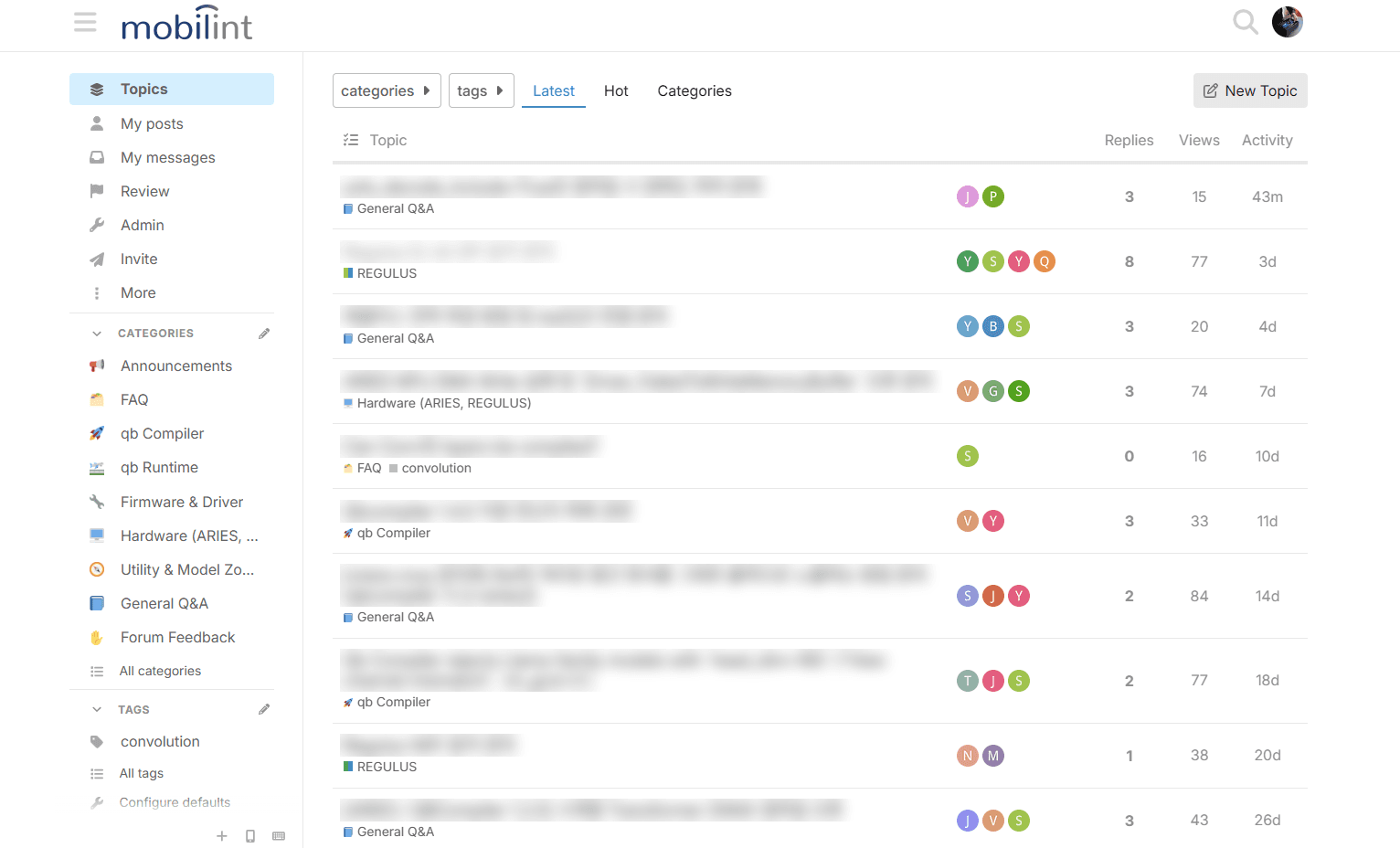
Mobilint’s technical forum, discuss.mobilint.com, where users can reach Mobilint engineers directly
Fast technical support for new models and frameworks
When you deploy an NPU, how well it supports your models matters. During initial setup, the fastest and most efficient way to validate an architecture is often to test with models the NPU vendor has already optimized. Mobilint maintains more than 490 validated model architectures, and CEO Yoo named that breadth as one of Mobilint’s key strengths.
“Mobilint’s biggest differentiator is how proactive they are. Beyond technical support, they work with us side by side on which markets we can target together.”
— Myung-hwan Yoo, CEO, XSLAB
A market thinking about what comes after the GPU
Why do you think customers are moving from GPUs to NPUs?
CEO Yoo: “For training and development, GPUs and other general-purpose processors are the standard, and staying with them is a valid choice. But once you move past training into production, GPU costs keep climbing as your user base grows. Data centers are a real estate business, so power per rack is everything.
A lower price cuts CAPEX, and lower power cuts OPEX. Over a 5–6 year server lifespan, that difference adds up. On the procurement side, depending on a single foreign vendor is risky, so demand for a Korean NPU-plus-server combination is growing.”
*CAPEX and OPEX
CAPEX: up-front cost of purchasing equipment
OPEX: ongoing operating costs such as electricity
The partnership is expanding into the field

Excerpt from Monthly XSLAB, April 2026 issue (Source: XSLAB)
For sites that can’t add another rack
XSLAB and Mobilint are focusing first on places like corporate facilities and in-building control rooms, where it’s hard to find new rack space for AI servers or where existing power and environmental conditions have to stay as they are. At these sites, rack space and power capacity are fixed, so even adding one server has to fit within the headroom of the existing facility.
The SQM100 was designed for exactly these conditions. Its 1U form factor takes up minimal rack space, and pairing a low-power Arm processor with the high-efficiency MLA100 PCIe Card keeps the power load down.
It supports Ubuntu Server and Rocky Linux, so teams already running those operating systems can evaluate it without changing how they operate. At unstaffed sites, it can be managed remotely through “XMAS,” XSLAB’s in-house remote server management system built on a BMC (baseboard management controller).

“With power-efficient NPUs and servers, and close collaboration, I hope we can do a lot of things other companies haven’t been able to.”
— Myung-hwan Yoo, CEO, XSLAB
Could this work in your environment?
XSLAB and Mobilint share one goal: power efficiency without sacrificing performance. Even at sites that need vision and LLMs running together, a low-power Arm server combined with a high-efficiency NPU can deliver the AI performance required while lowering operating costs. The two companies are refining their servers and NPUs together toward that goal.
If you want to bring in AI without changing your rack space or power budget, XSLAB and Mobilint will work with you to find the right configuration for your site.

Written by
Mobilint, Inc.
